
ISO week numbers count the weeks of the year from Monday to Sunday, and week 1 is the week that contains the year’s first Thursday. That puts week 1 of 2027 on Monday, January 4 to Sunday, January 10, and gives 2027 52 weeks. The system comes from the ISO 8601 standard and is used across Europe and in many workplaces.
How ISO week numbers work
The standard has three rules:
- Weeks start on Monday and end on Sunday.
- Week 1 is the week with the year’s first Thursday. Put another way, it is the week that contains January 4, or the first week with at least four days in the new year.
- A week belongs to the year its Thursday is in. So the first or last few days of a calendar year can belong to a week of the year next door.
That last rule surprises people. Friday, January 1, 2027 is not in week 1 of 2027: that week’s Thursday is December 31, 2026, so January 1 to 3, 2027 are part of week 53 of 2026. In the same way, Saturday, January 1, 2028 belongs to week 52 of 2027.
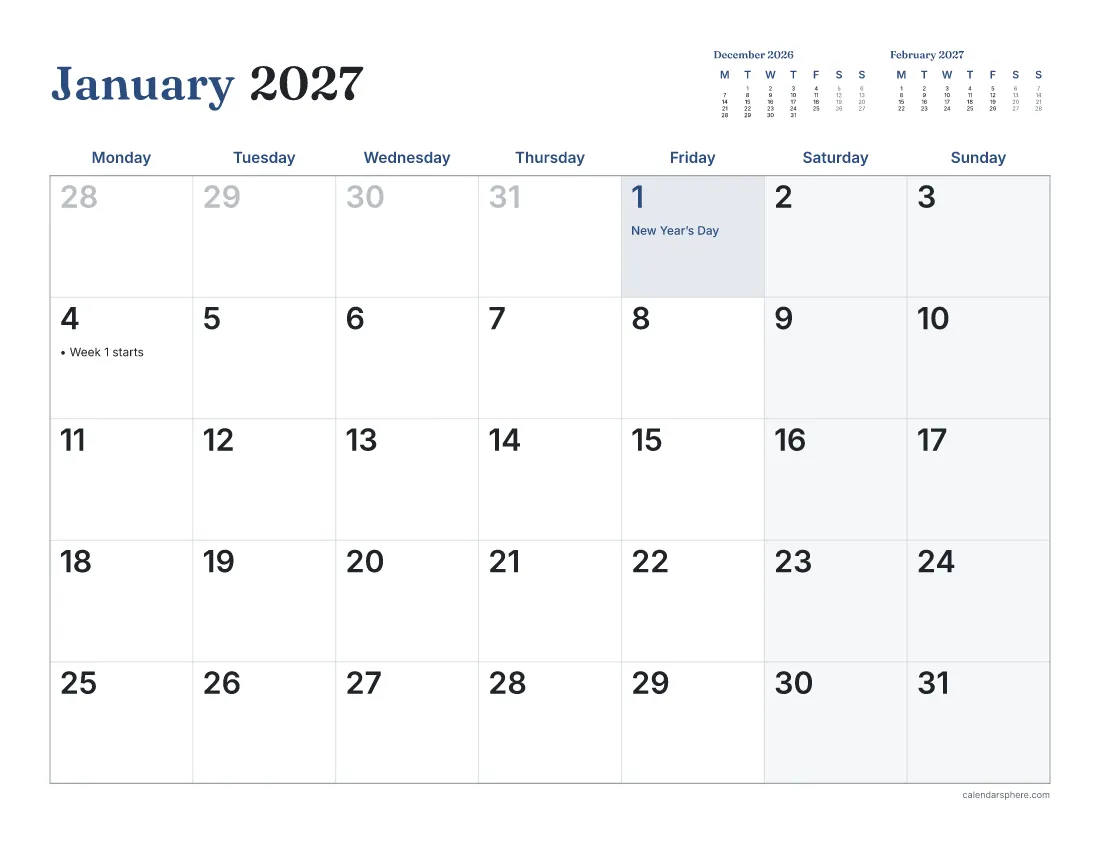
ISO week numbers for 2027
Some week numbers worth knowing in 2027:
| Week | Monday to Sunday | Notes |
|---|---|---|
| 53 of 2026 | December 28, 2026 to January 3, 2027 | Holds New Year’s Day 2027 |
| 1 | January 4 to January 10 | First week of 2027 |
| 12 | March 22 to March 28 | Ends on Easter Sunday |
| 26 | June 28 to July 4 | Holds Friday, July 2, the middle day of the year |
| 32 | August 9 to August 15 | Holds Friday, August 13 |
| 52 | December 27, 2027 to January 2, 2028 | Last week of 2027 |
The dated pages of the weekly planner print these numbers, and its page lists every week of the year with its Monday-to-Sunday dates.
How to work out the week number of any date
You can find any ISO week number with a calendar and a little arithmetic:
- Find the Thursday of the date’s week. Move to the Thursday between the Monday and Sunday around your date.
- Note that Thursday’s year. That is the year the week belongs to.
- Count the Thursday’s day of the year, where January 1 is day 1.
- Divide by 7 and round up. The result is the week number.
Example: Friday, August 13, 2027. Its Thursday is August 12, which is day 224 of 2027 (212 days from January to July, plus 12). 224 ÷ 7 = 32, so the date is in week 32. This is the same method the calendars on this site use.
To skip the arithmetic, the week number tool shows today’s week number and works out the week of any date you pick.

52 or 53 weeks
Because a year is 52 weeks and a day or two, the numbering sometimes needs a week 53. An ISO year has 53 weeks when it starts on a Thursday, or when it is a leap year starting on a Wednesday. 2026 starts on a Thursday and has 53; 2027 and 2028 have 52; the next 53-week year is 2032.
How many weeks are in a year has the full table of 52- and 53-week years and what the extra week means for planners and payroll.
Both of the next 53-week years, 2026 and 2032, start on a Thursday (2032 is a leap year too). The one before, 2020, was a leap year that started on a Wednesday.

Why your week number might not match
Not every calendar counts weeks the ISO way. Many US calendars start the week on Sunday and call the week containing January 1 week 1. Under that system, January 1, 2027 is in week 1, while ISO puts it in week 53 of 2026, and the two counts can differ by one for the rest of the year.
Spreadsheet apps have both. In Excel and Google Sheets, ISOWEEKNUM gives the ISO week number, while WEEKNUM uses a Sunday start by default. If you share week numbers with colleagues, suppliers or schools in other countries, ISO numbers are the safest choice.

Writing dates by week
ISO 8601 also lets you write a date as a year, week and weekday. Monday, January 4, 2027 is 2027-W01-1: the year, then W and the week, then the day of the week from 1 (Monday) to 7 (Sunday). Friday, January 1, 2027 is 2026-W53-5. You’ll see this format in production schedules, school timetables and software.

Using week numbers to plan
Week numbers are handy when a plan runs across months. “Ship in week 14” is shorter than “the week of April 5”, and a numbered weekly page makes it easy to see how many weeks are left in a term or a project. To make the most of each week once it starts, how to plan your week suggests a short routine. And if you like the quirks of the calendar, every Friday the 13th in 2027 is another date that moves from year to year.

Print a planner with week numbers
The weekly planner prints dated pages with the ISO week number at the top, for up to a year, in Letter or A4. For a year view, the 2027 calendar can add week numbers down the left side of every month, so you can see at a glance which week each date sits in.

Frequently asked questions
How are ISO week numbers worked out?
Weeks run Monday to Sunday, and week 1 is the week that contains the year’s first Thursday. Every week then takes the number of the year its Thursday falls in.
When does week 1 of 2027 start?
Monday, January 4, 2027. Week 1 runs to Sunday, January 10; January 1 to 3, 2027 belong to week 53 of 2026.
How many ISO weeks does 2027 have?
52. The last, week 52, runs from Monday, December 27, 2027 to Sunday, January 2, 2028.
Why does my calendar show a different week number?
Some calendars, common in the US, start weeks on Sunday and call the week with January 1 week 1. Near the start of a year that can put their numbers one ahead of the ISO week numbers.
What does 2027-W01-1 mean?
It is the ISO way to write a date by week: year 2027, week 1, day 1 (Monday). It is the same day as January 4, 2027.
Which week is Easter 2027 in?
Easter Sunday, March 28, 2027 is the last day of ISO week 12, which runs from Monday, March 22.