
Here is a budget categories list that covers most households: housing, utilities, groceries, transport, phone and internet, insurance, health, childcare, debt payments, savings, eating out, entertainment, clothing, gifts and giving, subscriptions, and other. Start with these 16, cross out any that don’t apply, and add a category for anything you spend on regularly that doesn’t fit.
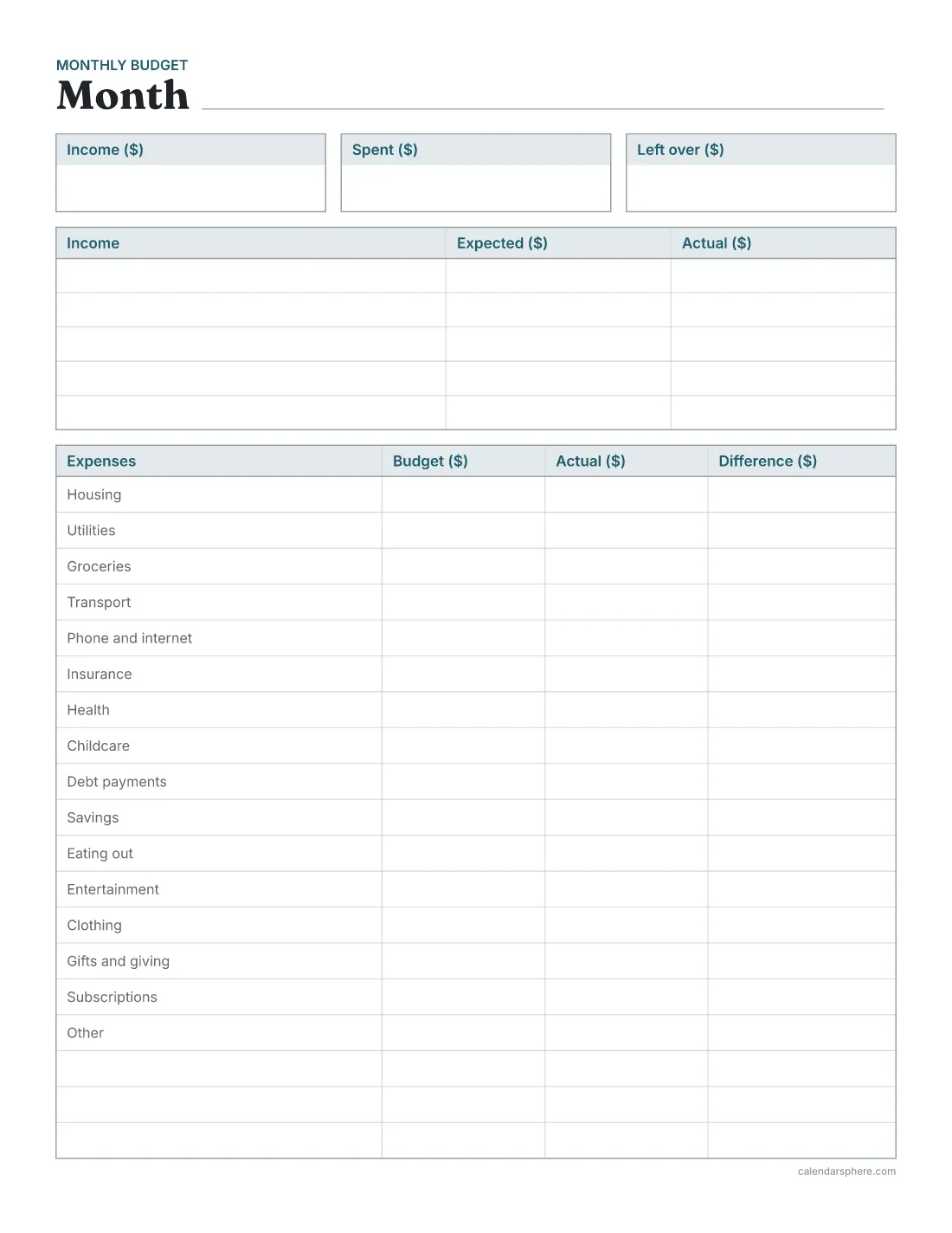
These are the 16 expenses written in on the printable budget planner, so you can start filling in a month straight away.
The budget categories list
| Category | What goes in it | Usually |
|---|---|---|
| Housing | Rent or mortgage, property tax, service charges, home repairs | Fixed |
| Utilities | Electricity, gas, water, heating oil, rubbish collection | Fixed or variable |
| Groceries | Food and household basics from shops and supermarkets | Variable |
| Transport | Fuel, public transport, car payments, parking, servicing, tolls | Variable |
| Phone and internet | Mobile contracts, broadband, landline | Fixed |
| Insurance | Home, contents, car, life, pet and travel insurance | Fixed |
| Health | Prescriptions, dental, eye care, gym, health insurance where it isn’t under Insurance | Variable |
| Childcare | Nursery, childminder, after-school clubs, babysitting | Fixed or variable |
| Debt payments | Credit cards, loans, student loans, overdraft | Fixed |
| Savings | Emergency fund, saving for a goal, retirement contributions | Fixed |
| Eating out | Restaurants, takeaways, coffees, work lunches | Variable |
| Entertainment | Days out, cinema, hobbies, events, books, games | Variable |
| Clothing | Clothes, shoes, school uniform | Variable |
| Gifts and giving | Birthdays, holidays, charity, collections | Variable |
| Subscriptions | Streaming, apps, memberships, magazines, software | Fixed |
| Other | Haircuts, one-off costs, anything that doesn’t fit | Variable |
“Fixed” means roughly the same each month; “variable” means it changes with what you do. The split matters, because variable categories are where a budget can usually be adjusted.


How to choose your own categories
The list above is a starting point. Make it fit your life:
- Cross out what doesn’t apply. No children, no Childcare. No car, fold parking and fares into Transport.
- Split categories that are always large. If Groceries is the biggest line every month, you might split it into Supermarket and Takeaway, or separate Baby supplies.
- Merge categories that are tiny. Clothing and Gifts might share a line if both are small.
- Add what you pay regularly. Pets, school costs, hobbies, a side business, money sent to family.
- Keep Other small. If Other is a big number every month, look at what’s in it and give the largest items their own line.

Around 10 to 20 categories is enough for most people. Fewer and you can’t see where money goes; many more and the budget becomes a chore to keep.
Group categories into needs, wants and savings
Grouping makes it easier to see the shape of your spending:
- Needs: Housing, Utilities, Groceries, Transport, Phone and internet, Insurance, Health, Childcare, Debt payments.
- Wants: Eating out, Entertainment, Clothing beyond the basics, Subscriptions, Gifts and giving.
- Savings: Savings, and any extra debt payments above the minimum.


Some categories sit in both. A basic phone contract is a need; an upgrade is a want. Decide what counts for you.
Here is an example split, shown as percentages of take-home pay. It is one common way people start, not a recommendation, and real budgets vary widely with income, housing costs and family:
| Group | Example share |
|---|---|
| Needs | 50% |
| Wants | 30% |
| Savings and extra debt payments | 20% |
If your needs take far more than half, that is normal in many places, not a failure. The point of the split is to see where your money goes, not to hit a target.
Don’t forget irregular costs
The categories that break budgets are the ones that don’t show up every month: car insurance once a year, a TV licence, school trips, holiday gifts, an annual subscription. For each one:
- Write down the yearly amount.
- Divide by 12.
- Budget that amount each month in its category, and set it aside until the bill arrives.

Gifts are the classic example. Our guide to setting a holiday gift budget shows how to spread the cost over the months before.
How to use the categories on a monthly budget
- Write your income for the month: pay and any other money in.
- Give each category a budget at the start of the month.
- Write what you actually spent as the month goes, or once a week from your bank statement.
- Look at the difference at the end of the month: budget minus actual shows where you were under and where you went over.
- Adjust next month’s budget using what you learned.


The budget planner is set out exactly this way: totals at the top, an income table (5 rows in portrait, 6 in landscape), and expense rows with columns for budget, actual and difference. The 16 categories above are written in for you, with blank rows left for your own (19 expense rows on a portrait Letter page and 22 on A4), or you can turn the categories off for all-blank rows. Choose $, £, €, ₹ or no currency symbol, and print a blank month or a dated page for each month of the year.
If you are paid every two weeks, some months bring an extra payday. The biweekly pay schedule for 2027 shows which months, so you can plan where that money goes. Mark bill dates and paydays on a 2027 calendar to see when money comes in and goes out. For the full process of building a budget from scratch, see how to make a monthly budget.
This is general guidance on organising a budget, not financial advice; for decisions about debt, saving or investing, talk to a qualified adviser.
Start with the list
Print the budget planner with the 16 categories written in, cross out the ones you don’t use, add your own, and fill in your first month.

Frequently asked questions
What are the main budget categories?
A simple list is housing, utilities, groceries, transport, phone and internet, insurance, health, childcare, debt payments, savings, eating out, entertainment, clothing, gifts and giving, subscriptions, and other.
How many budget categories should I have?
Enough to see where money goes, but few enough to keep up. Around 10 to 20 works for most households; merge categories you rarely use and split ones that are always large.
Should savings be a budget category?
Yes. Listing savings as a category means it gets planned like a bill, rather than being whatever is left at the end of the month.
What goes in the Other category?
Small, irregular costs that don’t fit elsewhere, such as a haircut, a parking fine or a school trip. If Other grows large, look at what’s in it and give the biggest items their own category.
What is the difference between fixed and variable expenses?
Fixed expenses are the same each month, such as rent or an insurance premium. Variable expenses change, such as groceries or eating out, and they are usually where a budget can be adjusted.
Where do annual bills go in a monthly budget?
Divide the yearly amount by 12 and budget that much each month in the matching category, setting it aside until the bill arrives.