
How many weeks in a year? 52 weeks and 1 day in a normal year of 365 days, and 52 weeks and 2 days in a leap year of 366. When years are split into numbered weeks, those spare days add up, so some years get a 53rd week: 2026 has 53 ISO weeks, and 2027 has 52.
How many weeks in a year, exactly
A week is 7 days, so the sums are short:
- Common year: 365 ÷ 7 = 52 weeks and 1 day (about 52.14 weeks).
- Leap year: 366 ÷ 7 = 52 weeks and 2 days (about 52.29 weeks).
That extra day or two is why a date moves one weekday later each year, or two after February 29. Your birthday on a Friday in 2027 falls on a Saturday or Sunday in 2028, depending on whether it comes before or after the leap day.
It also explains weekday counts. 2027 starts and ends on a Friday, so its 365 days are 52 full weeks plus one extra Friday, giving 261 weekdays. 2028 is a leap year that starts on a Saturday and ends on a Sunday, so its two extra days are both weekend days and it has 260 weekdays. That count is the starting point for the working days in 2027.


When a year has 53 weeks
Calendars that number their weeks need a rule for the days that don’t fit. The most widely used is the ISO 8601 standard: weeks run Monday to Sunday, and week 1 is the week that contains the year’s first Thursday. Under that rule a year has 53 weeks when:
- it starts on a Thursday, or
- it is a leap year that starts on a Wednesday.
Every other year has 52. The table counts the ISO weeks year by year:
| Year | ISO weeks | 53-week year |
|---|---|---|
| 2020 | 53 weeks | Yes |
| 2021 | 52 weeks | No |
| 2022 | 52 weeks | No |
| 2023 | 52 weeks | No |
| 2024 | 52 weeks | No |
| 2025 | 52 weeks | No |
| 2026 | 53 weeks | Yes |
| 2027 | 52 weeks | No |
| 2028 | 52 weeks | No |
| 2029 | 52 weeks | No |
| 2030 | 52 weeks | No |
| 2031 | 52 weeks | No |
| 2032 | 53 weeks | Yes |
| 2033 | 52 weeks | No |
| 2034 | 52 weeks | No |
| 2035 | 52 weeks | No |
2020 was a leap year starting on a Wednesday; 2026 and 2032 start on a Thursday. Between 2000 and 2050, only 9 of 51 years have 53 weeks, so it happens roughly every five or six years.
ISO week numbers explained goes through the rule in detail, including why January 1, 2027 belongs to week 53 of 2026.
How many weeks are in 2026 and 2027
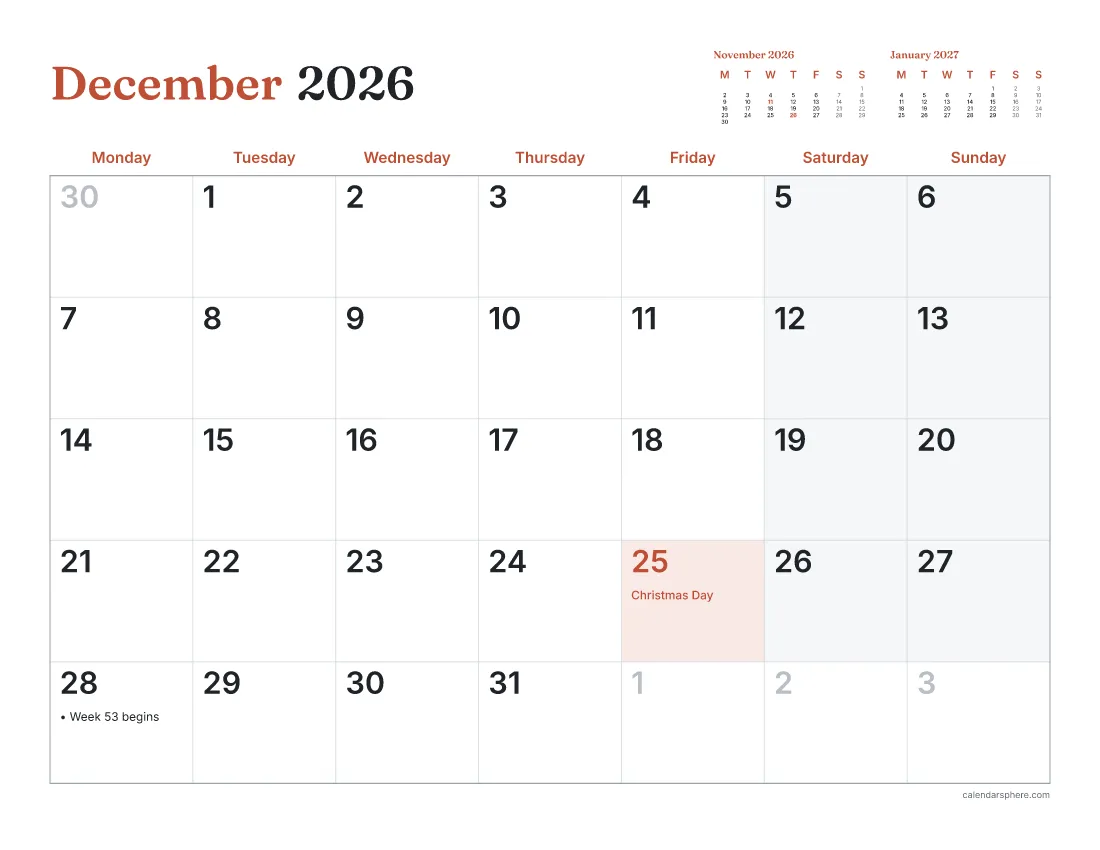
2026 has 53 weeks. It starts on Thursday, January 1, so week 1 runs from Monday, December 29, 2025 to Sunday, January 4, 2026. Week 53 runs from Monday, December 28, 2026 to Sunday, January 3, 2027.
2027 has 52 weeks. Because January 1 to 3, 2027 already belong to week 53 of 2026, week 1 of 2027 starts on Monday, January 4, 2027. Week 52, the last, runs from Monday, December 27, 2027 to Sunday, January 2, 2028.
2028 has 52 weeks too, even though it is a leap year: it starts on a Saturday, not a Wednesday or Thursday. Is 2028 a leap year covers what else the extra day changes.

Why the 53rd week matters
For most people, a 53rd week only shows up when a weekly planner or diary runs a page short. It matters more in a few places:
- Payroll. Weekly pay in a 53-week year can mean 53 paydays instead of 52, and biweekly pay can mean 27 instead of 26, depending on the day the schedule starts.
- Business reporting. Companies that report by week, or use a 52/53-week financial year, have to compare a 53-week year with a 52-week one.
- Planners and timetables. A dated weekly planner for 2026 needs 53 pages to reach the end of December.

Weeks per month
Months don’t divide into whole weeks either. February in a common year is exactly 4 weeks; every other month is 4 weeks plus 2 or 3 days (4 weeks plus 1 day for February in a leap year). That is why some months have five Fridays or five paydays, and others have four.

How to plan a year in weeks
If you plan week by week, a few habits help:
- Number your weeks. Writing the ISO week number at the top of each page makes it easy to match dates with colleagues, suppliers or school timetables.
- Check the year’s length. Before buying or printing a dated planner, check whether the year has 52 or 53 weeks.
- Watch the edges. The first and last weeks of a year usually spill into the neighbouring year, so a weekly page may show December and January together.

Print a planner for every week
The weekly planner prints seven days on a page, blank or dated, with the ISO week number on every dated page, so week 1 of 2027 starts on the right Monday. For the whole year at a glance, the 2027 calendar can show week numbers down the side of each month.

Frequently asked questions
How many weeks are in a year?
52 weeks and 1 day in a common year of 365 days, and 52 weeks and 2 days in a leap year of 366 days. As a decimal, that is about 52.14 or 52.29 weeks.
How many weeks are in 2027?
52 ISO weeks. 2027 starts on a Friday, so its first three days belong to week 53 of 2026, and week 1 of 2027 starts on Monday, January 4.
Does 2026 have 53 weeks?
Yes. 2026 starts on a Thursday, so it has 53 ISO weeks. The last one runs from Monday, December 28, 2026 to Sunday, January 3, 2027.
Which years have 53 weeks?
A year has 53 ISO weeks when it starts on a Thursday, or when it is a leap year that starts on a Wednesday. Between 2020 and 2035 that is 2020, 2026 and 2032.
How many weekdays are in a year?
260 or 261 in a common year and 260 to 262 in a leap year, depending on the day the year starts. 2027 has 261 and 2028 has 260.
How many weekly planner pages do I need for a year?
52 pages covers a full year of weeks. In a 53-week year such as 2026, add one more page so the last few days of December have a home.