
The 52 week savings challenge is simple: save $1 in the first week, $2 in the second, $3 in the third and so on, until you put away $52 in week 52. By the end of the year you have $1,378, without ever having to find a large sum in one go.
This guide shows how the challenge works week by week, two variations that suit different budgets, and how to scale it to a bigger goal.
How the 52 week savings challenge works

- Print the chart. Each row is a week, with the amount to save and the running total already written in.
- Pick a day. Payday or the first day of the week works well: move the money before you can spend it.
- Save the week’s amount and tick it off. The running total shows how far you have come.
- Keep the money apart. A separate savings account stops the challenge money from mixing with everyday spending.
| Week | Save | Total saved |
|---|---|---|
| 1 | $1 | $1 |
| 10 | $10 | $55 |
| 26 | $26 | $351 |
| 39 | $39 | $780 |
| 52 | $52 | $1,378 |
The last quarter is the hard part: weeks 40 to 52 alone add up to $598, and they land in October to December, the same months as holiday shopping. If December is tight for you, plan your holiday gift budget early, or try the reverse version below.
Fit the challenge to your pay schedule
If you are paid every two weeks, save two weeks at once on payday: weeks 1 and 2 together come to $3, and weeks 51 and 52 together to $103. Paid monthly? Add up the four or five weeks that fall in that month and move the whole amount on payday. The first four weeks ask for $10 in total; the last four ask for $202, so the gap between January and December is wide. Mark each transfer day on a 2027 calendar so it is planned, not remembered.
Variations of the 52 week savings challenge

The reverse challenge. Start at week 52 and work up the page: $52 in the first week, $1 in the last. The total is the same, but the large amounts come while New Year enthusiasm is high. In the standard version the first 26 weeks save $351 and the last 26 save $1,027; the reverse version flips that, so most of the money is already put away by midsummer.
The pick-a-week challenge. Tick any amount each week, in any order. Choose a big one in a good week and a small one when money is tight; you still finish with every box ticked and $1,378 saved.
A bigger goal. Multiply every amount by the same number. The savings challenge maker can write the amounts in for steps of $1, $2, $5 or $10:
| Step | Last week | Year total |
|---|---|---|
| $1 | $52 | $1,378 |
| $2 | $104 | $2,756 |
| $5 | $260 | $6,890 |
| $10 | $520 | $13,780 |
Is the 52 week challenge right for you?

It suits anyone who finds it easier to start small. Week 1 asks for a single dollar, so there is no barrier to starting, and the habit is already in place by the time the amounts get larger.
If you would rather save the same amount every week, divide your goal by 52 instead: $1,378 is about $26.50 a week. If you are paying off debt first, the debt snowball tracker lists debts smallest first, so every paid-off balance frees money for the next. For a faster boost, a month of no spending can fund several weeks of the challenge at once: see our no-spend challenge rules.
How to keep going all year
Most people who stop do so in the second half of the year, when the amounts grow. A few habits help:
- Automate it. A standing transfer on the same day each week removes the decision. Change the amount once a month, when you review your budget.
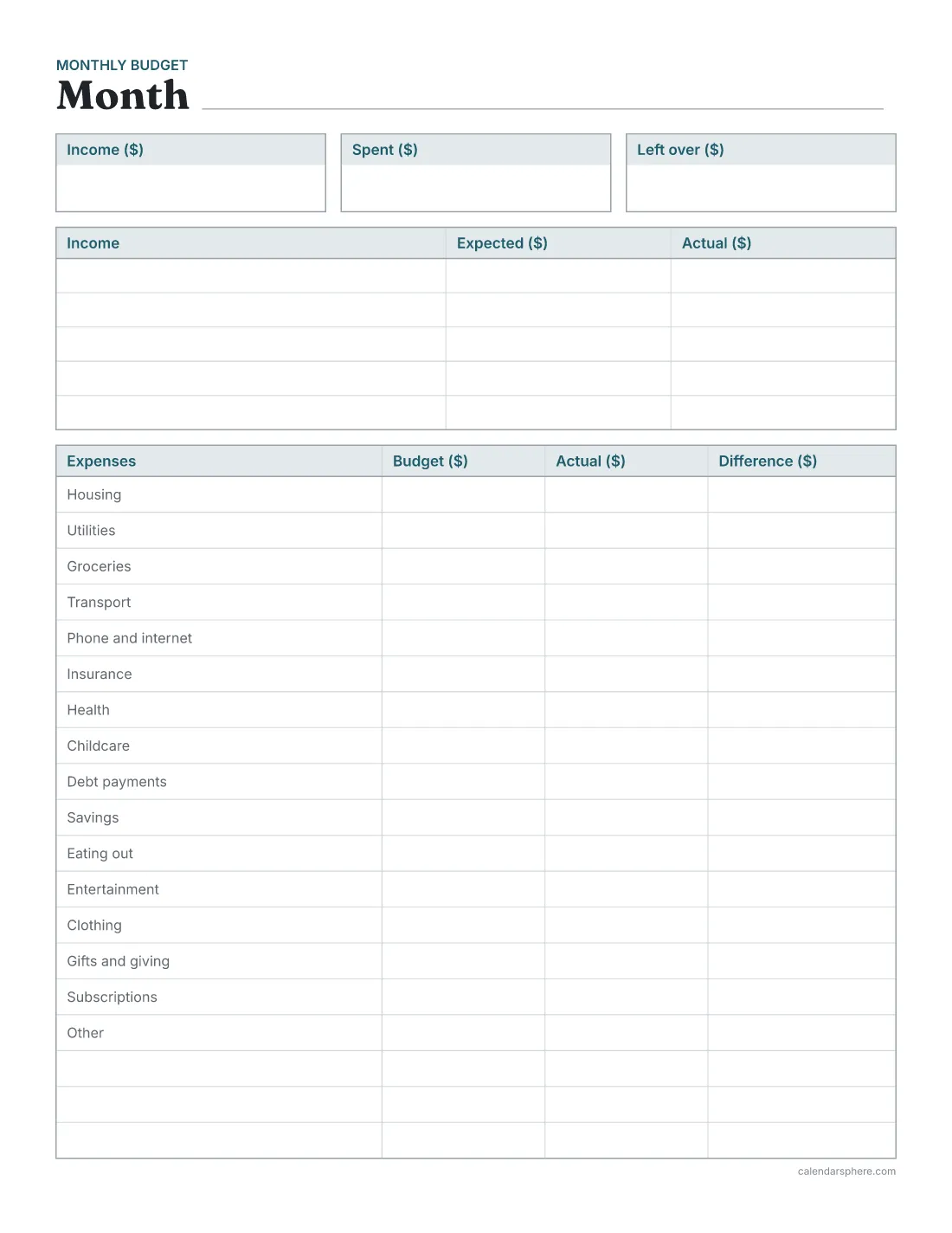
- Track it where you look every day. Tick the sheet, or add “Savings transfer” as a row on a habit tracker so a missed week is easy to spot.
- Plan for the expensive months. Look at the weeks that fall in November and December now, and decide whether to save ahead in the spring or use the pick-a-week version for those weeks.
- Don’t raid it. If something urgent comes up, an emergency fund is a better source. Keep the challenge money for its goal, whether that is a holiday, a deposit or a cushion for next year.
When the last box is ticked, write down what you did with the money and start the next sheet. Many people keep the same weekly transfer going, now at a fixed amount, because by week 52 it has become part of the budget.
Frequently asked questions
How much do you save with the 52 week savings challenge?
$1,378. Week 1 is $1, week 2 is $2 and so on up to $52 in week 52, and the numbers from 1 to 52 add up to 1,378.
Can I do the 52 week challenge in reverse?
Yes. Start with $52 in week 1 and work down to $1. The total is the same, but the biggest amounts come in January, when motivation is high, and the smallest in December, when money is tight.
How do I save more than $1,378?
Multiply every week by the same amount: steps of $2 save $2,756, $5 save $6,890 and $10 save $13,780. The printable sheet writes in the amounts for whichever step you choose.
What if I miss a week?
Catch up the next week, or swap: do any unticked amount that fits your budget that week. What matters is that every amount gets ticked by the end of the year.
Do I have to start in January?
No. Start any week and count 52 weeks from there. Write the start date at the top of the sheet.
Where should I keep the money?
Somewhere you won’t spend it by accident: a separate savings account you transfer into each week works better than cash in a jar, and may earn a little interest.