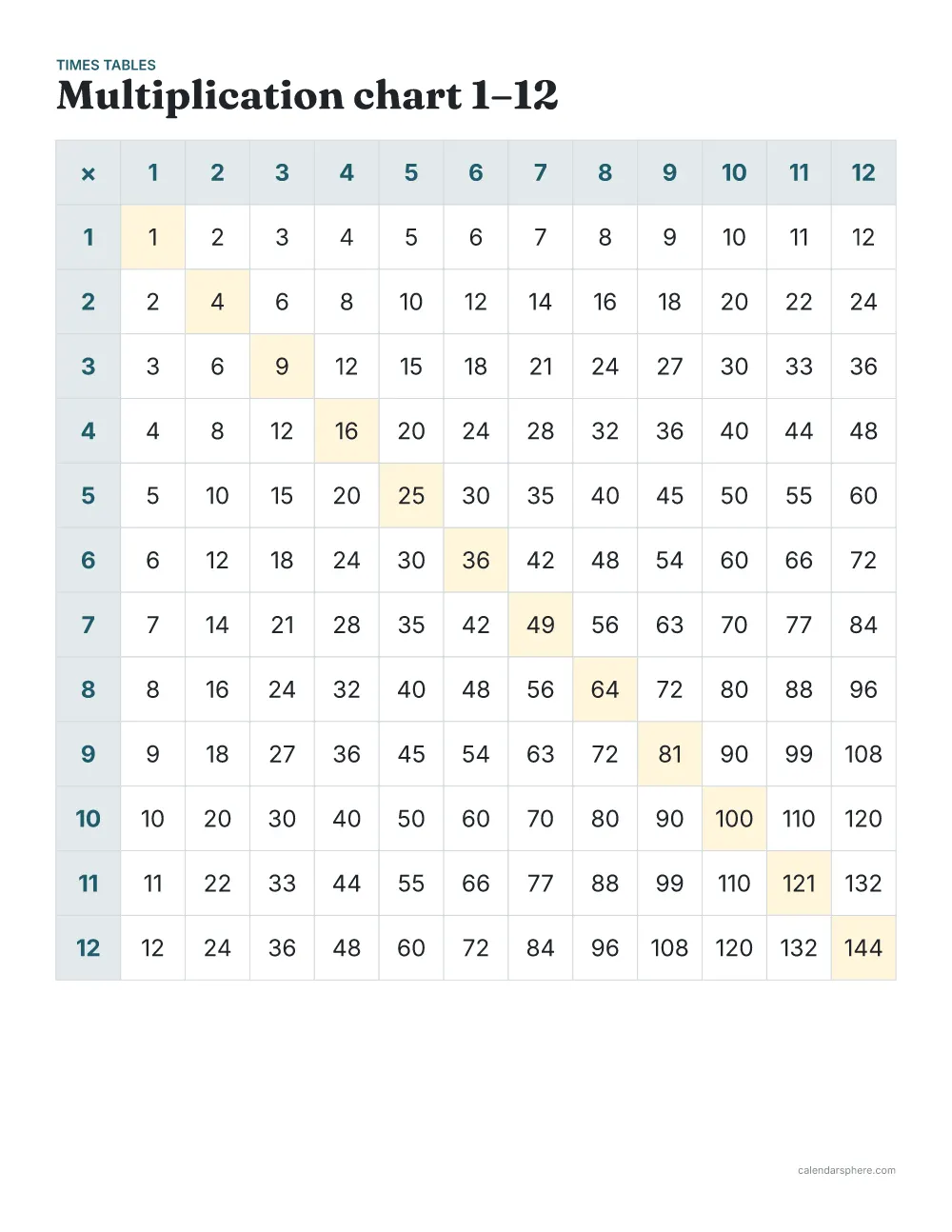
This multiplication chart printable puts every times table from 1 to 12 on one page: find a row and a column and read the answer where they meet. The square numbers down the diagonal are highlighted.
Free PDF, no sign-up
1 × 1 to 12 × 12
Square numbers highlighted
Print at “Actual size” or 100%.
1
Pages
Every page is the same, with a line for the date.
2
Sheet
3
Color
Used for headings and box labels; lines stay light grey.
4
Paper
Letter is standard in the US and Canada; A4 nearly everywhere else.
Or choose an insert size for a ring or disc-bound planner.
Find one number along the top row and the other down the left column; the answer is in the square where that column and row meet. 7 × 8: go across to 8 in row 7 and you find 56.
Why are some squares highlighted?
The diagonal holds the square numbers, a number times itself (4 × 4 = 16). The chart is mirrored across it, because 3 × 7 and 7 × 3 are the same.
Which times tables should children learn first?
Most start with 2, 5 and 10, then 3, 4 and 8, then 6, 7, 9, 11 and 12. Our guide to the order to learn times tables explains why.
Can I print other charts from here?
Yes. Switch the sheet to a hundreds chart, a place value chart or number lines in the options; each prints on Letter or A4.
Should children memorize the whole chart?
Not all at once. Use the chart to look answers up while learning, then cover a row and say its answers aloud. Most children learn the 2s, 5s and 10s first and use the chart less as each table sticks.
Cookies are used for stats and ads; your calendar choices and events stay on your device.Privacy