
How to make a monthly budget: add up what you take home, list your fixed costs, set an amount for each flexible category, make sure the total doesn’t exceed your income, then write down what you actually spend and compare. That’s the whole method; the six steps below fill in the details, with a sample split you can adapt.
You need a page with three columns for each expense (budget, actual, difference), an hour at the start of the month and ten minutes a week after that.
How to make a monthly budget in 6 steps


1. Add up your monthly income
Write down every regular amount that lands in your account: take-home pay (after tax and deductions), benefits, child support, side income. Use what you actually receive, not your salary.
If your pay varies, use a low but typical month. If you’re paid every two weeks, most months have two paydays and a few have three; the 2027 biweekly pay schedule shows which months get the extra one. Budget on two and treat the third as a bonus.
2. List your fixed costs
Fixed costs are the same, or nearly the same, every month: rent or mortgage, utilities, insurance, phone and internet, loan payments, childcare, subscriptions. Pull the amounts from last month’s statements rather than guessing.
3. Set amounts for flexible spending
Flexible costs change with your choices: groceries, eating out, transport, clothing, entertainment, gifts. Look at the last two or three months to see what you really spend, then set a figure that is realistic, not aspirational. A grocery budget you blow by the 20th teaches you nothing.
Not sure what to include? Budget categories: a simple list to start from walks through the usual headings and what goes under each.
4. Pay savings like a bill
Put savings in the expense list with its own amount, near the top. Money “left over at the end” has a way of not being left over. Even a small fixed amount builds the habit, and an emergency fund keeps one bad month from wrecking the next.
5. Make income minus expenses equal zero
Add up every budget line and compare it with your income. If expenses come out higher, trim the flexible categories first. If there’s money unassigned, give it a job: savings, an extra debt payment, or a category you under-budgeted. When every amount has a purpose, nothing quietly disappears.
6. Track the actual spending
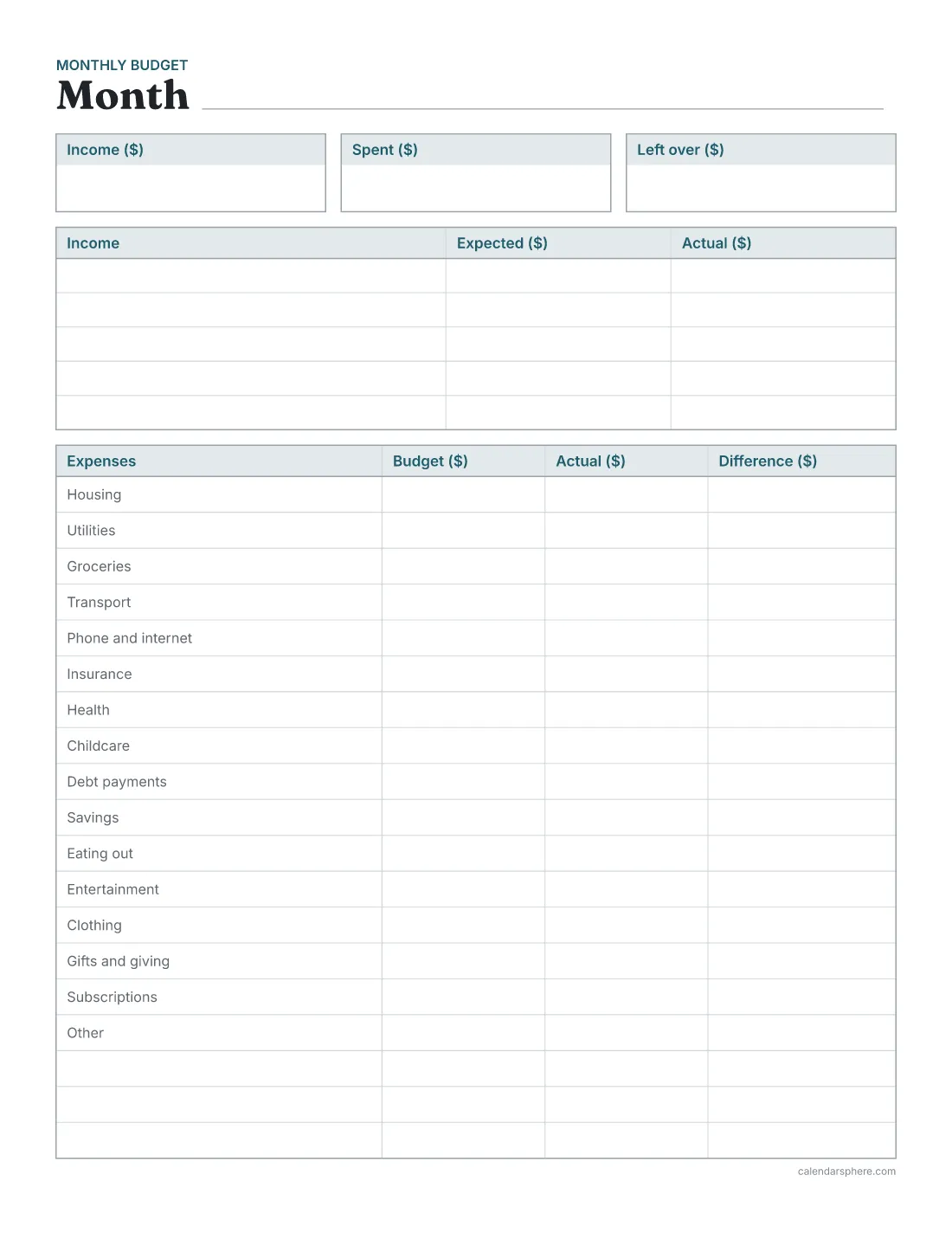
During the month, write what you actually spend in each category. Once a week is enough: sit down with your bank app or receipts and update the actual column. At month end, work out the difference for each line and note the two or three that went over. They tell you what to change next month.
A sample monthly budget split

Every household is different, so treat this as a starting shape, not a rule. A common rule of thumb is roughly half of take-home pay on needs, up to a third on wants and at least a fifth on savings and extra debt payments. Here is how that might look across categories:
| Category | Share of take-home pay | Type |
|---|---|---|
| Housing | 30% | Need |
| Utilities, phone and internet | 6% | Need |
| Groceries | 10% | Need |
| Transport | 6% | Need |
| Insurance and health | 4% | Need |
| Eating out and entertainment | 8% | Want |
| Clothing and personal | 4% | Want |
| Subscriptions | 2% | Want |
| Gifts and giving | 3% | Want |
| Other | 7% | Want |
| Savings and extra debt payments | 20% | Savings |
If housing alone takes more than a third of your pay, the other lines have to shrink to match, and that’s fine. The point is that the numbers add up to your income, not that they match anyone else’s.
Cutting the budget without misery

- Start with groceries and eating out. These are often the largest flexible lines. Planning meals for the week and shopping from a list is one of the simplest ways to bring them down; how to meal plan for the week shows how, and the meal planner has a shopping list beside the week.
- Review subscriptions once a quarter. Cancel the ones you didn’t use last month.
- Give yourself a small “anything” line. A budget with no fun money tends to get abandoned.
Common budgeting mistakes
- Forgetting irregular costs. Car repairs, annual fees, birthdays and holidays happen every year. Add up the yearly total, divide by 12 and set that aside monthly. A 2027 calendar with renewal dates and birthdays written in makes them hard to miss.
- Budgeting from your salary. Plan with take-home pay, after tax.
- Only planning, never tracking. The actual column is where you learn. Without it, the budget is a wish.
- Giving up after one bad month. Overspending in month one is normal. Adjust the numbers and go again; most budgets take two or three months to settle.
- Making it too detailed. If tracking takes longer than ten minutes a week, merge some categories.
Using a printed budget sheet

A paper budget forces you to look at every number as you write it, which is half the value. The budget planner maker prints a month on one page: boxes at the top for income, spent and left over, an income table with expected and actual, and expense rows with budget, actual and difference. You can choose a currency symbol, and start from 16 common categories already written in (Housing, Groceries, Savings and so on) or from blank rows.
Print a blank month to reuse, or dated months for a quarter or a whole year, and set next month’s budget before it begins.
Frequently asked questions
What is the first step in making a monthly budget?
Work out what comes in each month after tax: your take-home pay plus any other regular money. Every other number in the budget is planned against that total.
What if my income changes from month to month?
Budget on your lowest typical month, then treat anything above it as extra for savings or debt. That way a quiet month doesn’t break the plan.
How do I budget if I’m paid every two weeks?
Plan most months on two paychecks. In the few months that bring a third, the extra pay can go straight to savings, debt or a bill due later in the year.
How many budget categories should I have?
Enough to see where money goes, few enough to keep up: around 10 to 16 is a common range. Too many categories make tracking a chore, and too few hide problems inside “Other”.
What does the difference column on a budget show?
Budget minus actual for each expense. A positive number means you spent less than planned; a negative one shows where the month went over, so you can adjust next month.
How often should I update my budget?
Write in actual spending at least once a week, so the month never gets away from you, and set the next month’s budget a few days before it starts.