
Here is how to plan your year in one afternoon: look back at last year, choose three to five goals, put every fixed date on a year calendar, then split each goal into monthly steps and weekly habits. Finish by deciding when you’ll check in, because a plan you never look at again is only a wish list.
You don’t need an elaborate system. A one-page year calendar, a notebook and a habit tracker cover it.
Step 1: look back before you look ahead
Spend 20 minutes on last year before you plan the next one. Write short answers to:
- What went well, and why?
- What didn’t happen that you meant to do? What got in the way?
- What took more time or money than you expected?
- What do you want more of, and less of?

Patterns show up quickly. If “exercise more” appears every year and never happens, the next plan needs a smaller, more specific version, scheduled on actual days.
Step 2: choose a few goals for the year
Pick three to five goals across the areas that matter to you: health, work, money, family, learning, home, fun. More than five and none of them get enough attention.
Make each one concrete:
| Vague | Concrete |
|---|---|
| Get fit | Run a 5 km race in the spring |
| Read more | Read one book a month |
| Save money | Build an emergency fund by the end of the year |
| Sort the house | Clear one room a month, starting with the garage |
A concrete goal tells you when you’ve done it, and it can be broken into steps.
Step 3: put the fixed dates on a year calendar
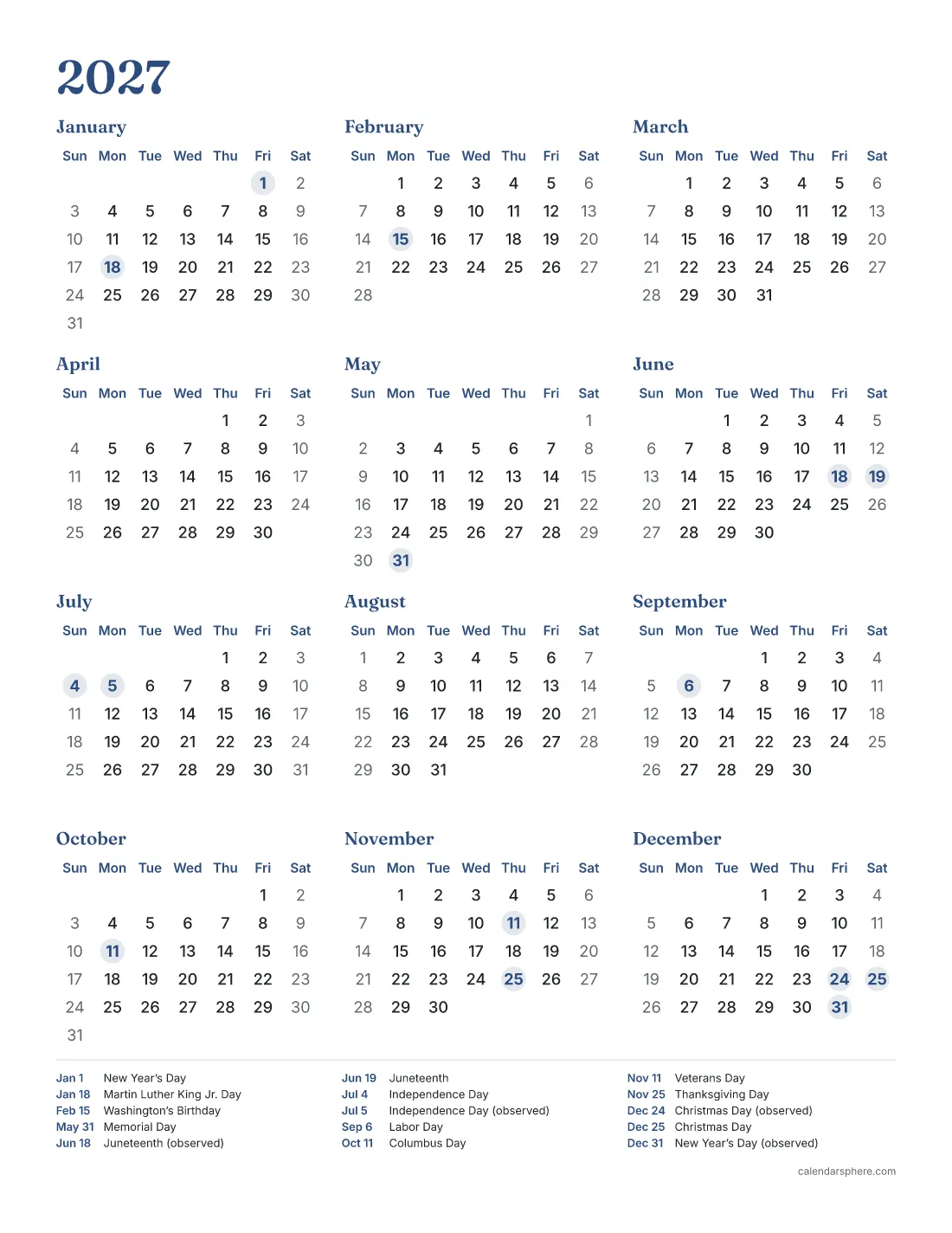
Before you schedule anything new, mark what is already decided. A year-at-a-glance calendar shows how the months really fill up.

- Public holidays and long weekends
- School terms and holidays, if you have children
- Birthdays and anniversaries
- Work deadlines, busy seasons and planned leave
- Trips, weddings and events already booked
- Bills or renewals that come once a year
The 2027 calendar maker prints all twelve months on one page or one month per page, with the public holidays for the US, UK, Canada, Australia or India already marked and room to add your own dates. 2027 starts on a Friday and ends on a Friday, has 365 days and 52 ISO weeks. If you’re planning time off, our list of US long weekends in 2027 shows where holidays create three- and four-day breaks.
Once it’s all on paper, you’ll see the crowded months and the empty ones. Plan big pushes for quieter months.
Step 4: break goals into monthly steps
Take each goal and work backwards from the end date. What needs to be true one month before? Three months before? Write one milestone per month, then place it on the calendar.

Example, “run a 5 km race in the spring”:
- January: walk-run three times a week, 20 minutes.
- February: run 2 km without stopping.
- March: run 3.5 km; enter the race.
- April: run 5 km twice before race day.
Spread the goals so not every milestone lands in the same month, and leave slack around holidays and busy seasons.
Step 5: turn steps into weekly habits
Milestones happen because of what you do each week. For each goal, write the habit that moves it forward: “run on Monday, Wednesday and Saturday”, “read 20 minutes before bed”, “transfer savings on payday”.


A monthly habit tracker keeps those habits visible. Each habit gets a row and each day a box to tick, from 5 to 20 habits per page. Print dated months, with the weekdays above each day and weekends shaded, or blank months to use any time. Start with three to five habits; more is hard to keep up. Our guide on how to use a habit tracker has tips for sticking with it.
To make sure the habits actually get time, block them into your week. Time blocking explains how to give each priority a slot in your calendar.
Step 6: decide when you’ll review
Put the reviews on the calendar now, while you’re motivated:
- Weekly (15 minutes): look at the week ahead, check this week’s habits, move anything that slipped. Our weekly review guide has a simple checklist.
- Monthly (30 minutes): did you hit the milestone? Fill in next month’s habit tracker.
- Quarterly (an hour): are these still the right goals? Drop or change the ones that no longer fit.

Changing a goal isn’t failing. Plans that adjust to real life are the ones that last until December.
How to plan your year on one page
If you want it all in one place, put these on a single sheet next to your year calendar:
- Your three to five goals, written as concrete outcomes.
- One milestone per goal per quarter.
- The weekly habits that move each goal forward.
- Your review dates.
Pin it up, or keep it at the front of your planner, and look at it every week.
Print your year
Start with the dates: the 2027 calendar maker prints your year with holidays and your own events, and a monthly habit tracker turns your goals into boxes to tick each day.

Frequently asked questions
When is the best time to plan the year?
Late December or the first week of January works for most people, but any quiet afternoon does. A school year, financial year or birthday can be just as good a starting point.
How many goals should I set for the year?
Three to five is plenty. Fewer goals get more attention, and each one should be broken into steps you can schedule.
What should go on a year calendar first?
Fixed dates: public holidays, school terms, birthdays, anniversaries, work deadlines and booked trips. Plan goals around them, not the other way round.
What is the difference between a goal and a habit?
A goal has an end point, such as running a 10 km race. A habit is something you repeat, such as running three times a week, and it is how most goals are reached.
How often should I review my yearly plan?
Look at the week ahead every week, check progress at the end of each month, and do a longer review every quarter, adjusting goals that no longer fit.
How many weeks are there in 2027?
2027 has 52 ISO weeks. It starts and ends on a Friday, has 365 days and 261 weekdays.